
My Summer Reading List
(OK, maybe "Summer," as in "light" reading is not quite correct here. Judge for yourself.)


Growing up as a working class white kid in the Philly suburbs and a Catholic, the world of Left organizing and Jewish history didn't come alive for me until I moved to NYC in the late 1970s. While attending The Cooper Union, I rented a room from Sophie Saroff, a former Left labor organizer born a Jew in the Ukrainian Pale in the late 19th century. This encounter became my second upbringing and first real political education. And what began with Sophie, continues now—fifty years later—through Molly Crabapple's remarkable and moving book Here Where We Live Is Our Country.
There is much to praise here, and some things to question, as is true for any political history attempting to challenge our understanding of the past. Above all else, Crabapple delivers detailed research about the Jewish Bund in such a way that readers simultaneously walk the streets of Nazi-occupied Eastern Europe distributing leaflets and calling other workers to arms, while also stepping back to evaluate the specific politics, tactics, and longer-term strategies that this little-known group of radical socialists brought to bear on their time and place in history.
Put differently: "history" both comes alive in all the ways a great read should, while providing the analytical framework to understand people, places, and events within a larger temporal context. Most of all, this book is not a work that begins and ends in a far-off place; it instead lives in our present, bringing to bear all of its analytical rigor and moral complexity on current events—the good, the bad, and that which is worthy of ongoing discussion and debate. As Zoe Beloff states in her new book (see below) “How can we reach out to comrades across time?” Crabapple’s opus certainly offers one answer to that time-traveling entreaty.

Theorist Marco Baravalle’s The Battleground of Art: Radical Curating in the Crisis of Neoliberalism wastes no time launching us into an intellectually transformative, politically rejuvenating journey of Left cultural resistance. It begins with a meticulous first-person account of installing an enormous Indonesian woodcut banner of political resistance by Taring Padi, then sweeps us backward through Italian Operaismo, the Hot Autumn of 1968, the anni di piombo (years of lead), the collapse of the socialist east, the failure of the Keynesian welfare state, and the rise of neoliberalism—arriving finally at what I call the Unpresent: that condition of stalled time in which globalized capital reproduces itself through racism, ethno-nationalism, and endless value extraction.
It is within this landscape that those within and adjacent to social movements—including Baravalle and his comrades at Sale Docks in Venice—debate, struggle, reconsider, and push back against modern capitalism’s relentless drive to extract value, divide workforces, and naturalize domination. The long march of artistic resistance continues, grappling persistently with the central question: to join the institution, seek to reform it, reject it, or actively reinvent it?
Baravalle’s answer crystallizes in this crucial passage: “Every time artistic creation dares to become social creation, the alter-institutional horizon becomes visible, and the power of its global infrastructure can be grasped.” It is this alter-institutionality—democratic, autonomous, internationally oriented, anti-capitalist—that Baravalle offers as the most urgent, precise, and significant vision of cultural futures available to us today.

Snubbed, reassigned positions, passed-over for promotion, in her autobiographical book Art World Feminist Patricia Hills chronicles eighty years of fighting the good fight as art historian, feminist, marxist, activist, and teacher, but also daughter, wife, mother, and grandmother, at times she was all of these at once. Along this journey that is lucidly written to illuminate recent history as much as engage our human to human recognition, Hills recounts numerous encounters as well as struggles. At the Museum of Modern art in the early 1960s she worked with surrealist Max Ernst alongside critic and activist Lucy R. Lippard. Hill finds her voice as a feminist thinker and social critic later in the decade, studies with Meyer Schapiro (who never forgave her for auditing rather than registering for his class), along with fellow art history student Leo Steinberg.
In the 1970s she is introduced to Marxian art history via Carol Duncan and Alan Wallach. This in turns leads a decade later to working with Moe Foner of 1199 Health & Hospital Workers’ Union to organize an exhibition in 1983 for their 43rd Street Bread and Roses gallery entitled Social Concern and Urban Realism: American Painting of the 1930s (* Stay tuned for a Labor Art Review piece by Jennifer Jones about these projects from the 1970s and 1980s.)
Hills also wrote significant, scholarly monographs about politically engaged American painters, both white and Black, men and women, from Jacob Lawrence, Stuart Davis, Whitfield Lovell, and Eastman Johnson, to Alice Neel, and May Stevens, the last who is described in especially moving detail including the scattering of the artist’s ashes, along with those of her husband Rudolf Baranik, in Berlin’s Landwehr Canal where Karl Liebknecht and Rosa Luxemburg, Stevens’ hero, met their ends in 1919. Perhaps above all, Pat Hills is known for her early reinterpretation of American art and visual culture, making this volume an excellent companion to Armani and Siegel’s What Was America?

Elise Armani and Katy Siegel’s enlightening and entertaining What Was America? Art, Culture, and Politics in the Bicentennial Era is certainly essential reading in this 250th year of the US Declaration of Independence and the founding of the republic. Armani and Siegel serve up a core-sample of a previously under-studied national-memorial exhibitions and events from the bicentennial year of 1976, the year I was packing to move to New York from the suburbs of Philadelphia. Avoiding jargon or an overly-technical analysis, the reader is introduced to a surprisingly wide topography of cultural phenomenon ranging from broadcast television programs, commissioned paintings, commemorative medallions and logos, museum exhibitions, time capsules of assorted types including one that is decidedly “avant-garde,” a hand-stitched BiCentennial “People’s Quilt,” and the Marxist-oriented social art history publication produced by Artists Meeting for Cultural Change (AMCC) called An Anti-Catalog.
The overriding argument both recognizes a wider range of practices and material culture than only those of European-derived fine art, but it also raises fundamental questions about what constitutes the art and culture of a particular nation in search of its common identity, especially one with a very heterogenous population and highly contested history. In encounters with art made in cosmopolitan urban centers such as New York City as well as rural communities in Appalachia and agricultural regions in Texas and Kentucky, the radical Left politics of Benny Andrews, Hans Haacke, and Art Workers Coalition along with characters such as Peter Marzio who preserved hand-painted shop signs for the Smithsonian and biblical quilt-maker Harriet Powers who was born a slave in Georgia.
Thanks to this inclusivity the authors are also able to weave into their narrative late 20th century attempts at reviving or reimagining the Works Progress Administration’s Federal Arts Project support for artists including CETA but also expanding the NEA, along with such debated concepts as cultural populism, aesthetic pluralism, as well as debating divisions between “serious” or “advanced” fine art practices, and that of Americana, folk crafts, Sunday Painters and hobbyists. Overall, it adds substantially to a wide range of conversations and disputes about the ever-changing shape of culture within a diverse society that is undergoing yet another period of confrontation that is already having a deep impact on the state of the arts broadly speaking.

Erin Turner’s TOTEM: As Monument & Archive is simultaneously a reflection on the near-decade long process she undertook of restoring the Ed Galloway Totem Pole Park in northeastern Oklahoma, and the complex weaving stories that gave birth to this particular folk art installation in the 1930s. Visually rich with both images of the restoration process as well as the history of the region, the work, and the artist, Turner incorporates the thoughts and words of over a dozen contributors whose perspectives span Indigenous scholarship and artistic practice, curatorial and archival expertise, community history, and critical journalism—together forming a counternarrative to conventional monument narratives. Monuments both in a general historical and artistic sense also play a key role in TOTEM. Turner asks a key set of interlocking questions in this regard
“Perhaps we never think about the persons represented in bronze monuments as we walk through cities. Yet we still stare at them or at least glance at their feet in our periphery as we walk by, colliding with a distant time to which we no longer relate. We wish that public space could be democratic space, yet we are also trying to conceive how public space can truly represent the human fabric of our places and the ideals of our present, while equally honoring those who have walked before us. Can we actually create a figure that projects to the future with equal admiration for the past, or are we in desperate need of social and political repair before we can envision what an inclusive future space could feel like?” (29)
Especially in light of the not so distant global spate of monumenticides in which racist and colonialist representations were physically tagged, vandalized, or removed by states, municipalities, as well as BLM activists, TOTEM offers a reflection on this prospect of memorializing the ephemeral nature of collective labor and social inclusivity. Along the way the book raises awareness of Native American history and culture from Acoma Massacre of Pueblo people in 1599 by the Spanish, to the arrest and relocation of Apache people after Geronimo’s defeat in 1886, to the forced assimilation policies of Indian boarding schools, the Dawes Act’s dismantling of tribal lands, and the Indian Reorganization Act’s attempted federal restructuring of tribal governance in the 1930s—the very decades when Galloway conceived his monument. Turner’s answer to her own previous speculation about future monuments is worth citing here as it aligns with ideas presented in my own new book briefly discussed below:
“What if the new monument actually became an act of preservation, and one that held at its core the importance of biodiversity, of equilibrium? Of reuse and the vernacular? What if the new monument was a series of ephemeral acts and dialogue?”

“In the poverty jetset, we find ourselves chronically confronted with a simple, haunting question: How is it possible that so much money is made in the arts, but not by the people who make the art?” And with this premise, Sepp Eckenhaussen launches into an accessible and often humorous review of what he calls heterodox economies developed by contemporary art workers in Goodbye Poverty Jetset: How Art Workers Make Solidarity Economies. Significantly, Eckenhaussen starts off by faulting both the vertically organized revolutionary movements which sought to overthrow capital, Russia in and after 1917 in particular, but also the horizontality of 1968 and cultural politics afterwards. As for the former he summarises that it “failed to overthrow capitalism” soon leading to a disenchantment with the Soviet experiment.
As for the latter with a focus on Occupy Wall Street he writes that “almost none of the 2011 mobilisations managed to scale up from square occupations into serious, long-term movements with institutional footholds, capable of creating material change.” Opting for a pragmatic approach, the author proposes no “unitary blueprint,” but proposes instead “something better, and I would even say more useful: a set of strategic principles to inform the continuous management and adjustment of art workers’ organising” launching into a set of Organizing Principles that celebrate “small victories,” in order to build better from there. His introduction is not surprisingly entitled “In Defence of Bad Life Decisions.” Indeed.

Lucas Fortunato accomplishes something doubly remarkable in his new work about Critical Art Ensemble (CAE) whose co-founder Steve Kurtz was tragically lost to us just last November. Even as Fortunato provides readers with a meticulously researched account of the activist art collective in Critical Art Ensemble: The Artistic War Machine and the Anthropotechnical Arsenals of Revolt, he mobilizes CAE’s dark radiant energy to reverse-engineer the entire history of the avant-garde, chapter and verse. Crucially, Fortunato avoids a singular climactic resolution, instead weaponizing CAE’s battle-hardened poetic machinery as an anthropotechnical instrument for confronting what he calls the unpresent: that uncanny collective suspicion that the very idea of a more joyous or equitable socio-economic system—whether past, present, or future—has been deleted from our consciousness.
This is the story of art as revolt. Fortunato uses CAE’s confrontational approach to ask what it means to create and resist when hope itself has been erased from the realm of possibility. The book doesn’t offer easy answers or comfort, but rather accelerates the reader toward an urgent recognition: that the lessons learned from CAE’s practice demand to be put into action now. Read it, discuss it, read it again—but above all, act on what it teaches.

One last book but not the least is Zoe Beloff’s new illustrated volume Life Forgotten, which I just ordered so I can only quote here from the book’s description:
“Life Forgotten is an artwork, a collection of images and texts centered on a film. It takes place on a small corner of the Lower East Side, an immigrant neighborhood in New York at the beginning of the twentieth century. At its center is a little storefront movie theater that was a welcoming space for a group of radical young women garment workers. The book poses questions and offers a few signposts. How does history grow out of and weigh upon lived experience? How can people without power or influence change their world? How can we reach out to comrades across time?”
Oh, and one more on my summer list which I am still waiting to obtain:
How Did We Get Here: Reading Vasif Kortun by Turkish curator and theorist Vasif Kortun with contributions by Manuel Borja-Villel, Charles Esche, Prem Krishnamurthy, Céline Condorelli, November Paynter, Defne Koryürek, and Joshua Decter. Kortun will undoubtedly have a lot to say about the radically shifting political landscape in his native country over the past few decades, and that in turn will certainly prove relevant to conditions in the United States and elsewhere as ethno-nationalism spreads.

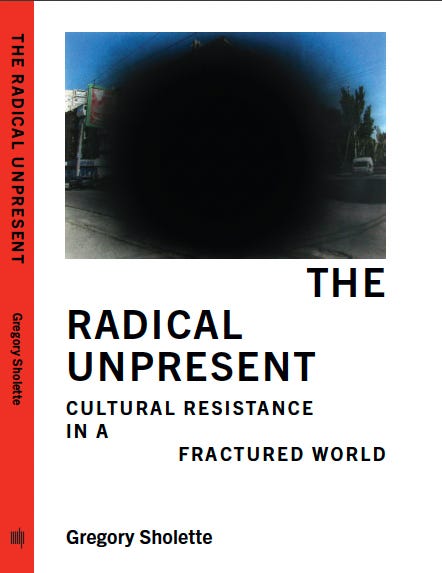
And before signing off, allow me to entice you with a bit more about my own forthcoming work, The Radical Unpresent. Cultural Resistance in a Fractured World, by presenting you with the book’s Table Of Contents, which also perhaps answers Beloff’s haunting question about how to reach comrade’s across time:
INTRODUCTION: ENTERING THE UNPRESENT
PART I: DIAGNOSIS
DARK MATTER REVISITED
MAGA: OUR NEW (RETRO) AVANT-GARDE
THE UNCANNY VALLEY OF MAGA 2.0
TOTAL CAPITALIST AESTHETIC
THE UNPRESENT AS CAPITALIST UNREALISM
PART II: GENEALOGY
WHITHER THE UNPRESENT?
LEARNING AFTER NEOLIBERALISM
THE CULTURAL ASPIRATIONS OF THE NATIONALIST RIGHT
INTERLUDE: A POST-AVANT-GARDE MONTAGE
PART III: RESISTANCE
THE PHANTOM ARCHIVE
DAVID SCOTT: PROBLEM-SPACE/TIME
STEVE EDWARDS: TIME’S CARCASS
PART IV: REPAIRS
CONSPICUOUS REPAIRS
DREAD SCOTT’S ARCHIVAL ACTIVISM
TATLIN ET AL.: REVOLUTIONARY REPURPOSING
KRISTEN ROSS: AFTERLIVES OF THE COMMUNE
GHOST SHIPS
CONCLUSIONS: TIME AGAINST ITSELF
Thanks for these book reviews, Greg. When I read Molly’s book, I felt like my ancestors came to life and that the history that guided my father’s anti-Zionism was finally seen. So grateful to her for learning Yiddish and doing the research. I’m leading a discussion about her book for the students and mentor faculty at the Institute for Social Ecology next week. Also good to know about Pat Hills book. I believe that I worked with her daughter at California State University, back in the day.
Thanks so much for the lovely write-up for Pat Hills' book, much appreciated. Tim Sheard (her editor).